

QuantalX pioneered a new approach to objectively assessing brain function. Its device, Delphi-MD, earned FDA De Novo clearance, a first of its kind authorization, and CE marking under MDR. Using Direct Functional Brain Diagnostics, Delphi-MD gives clinicians a non-invasive, radiation-free, and pain-free measure of brain function, making direct brain function assessment available in everyday clinical settings, not just research labs.
As Delphi-MD expands into broader clinical adoption, scaling across clinical sites creates new connectivity requirements. To enable that next phase of growth, QuantalX chose to partner with BioT, accelerating its connected-platform strategy while keeping its engineering focused on neuroscience and its core technology.
The starting point: a cleared device with no cloud
Delphi-MD was a fully on-premise, disconnected device. To scale in the US and EU, QuantalX wanted to do far more than lift it to the cloud. The goals for the connected platform were clear:
- Remote access to results: give clinicians and patients secure access to Delphi-MD results and data.
- System management: manage devices, firmware updates (FOTA), remote access, and advanced logging.
- Access to data: centralize data to support ongoing research and future algorithm development.
- License management: control device licensing across clinics.
Rather than build and run this infrastructure itself, QuantalX partnered with BioT to enable that next phase of growth while keeping its engineering focused on neuroscience and its core technology.
About Delphi-MD
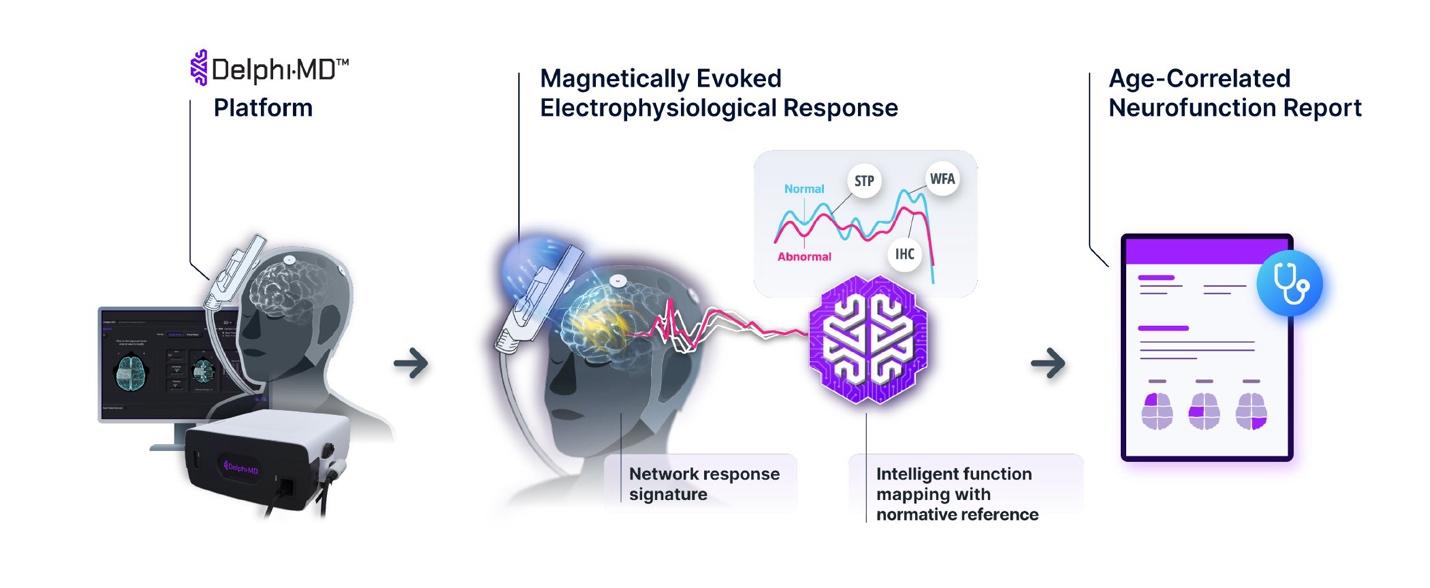
Delphi-MD delivers a direct, objective assessment of brain function through a simple, guided workflow: Activate, Read, Guide. The test is short, non-invasive, and fits into existing clinical workflows across brain health, neurology, psychiatry, and research, producing a comprehensive, age-correlated report that helps clinicians assess brain function.
The underlying technology had existed in research for roughly two decades but was not practically available in clinics. QuantalX packaged the heavy signal-processing algorithms and a guided acquisition workflow into a device that medical centers and hospitals can run directly. It is already deployed across major Israeli hospitals, with European and US commercialization underway.
Why QuantalX chose BioT
QuantalX made a strategic choice. Rather than build and maintain connectivity infrastructure itself, it partnered with BioT to accelerate its connected-platform strategy and keep its engineering focused on neuroscience and its core technology. Building on BioT gives QuantalX:
- Faster time to market. A ready, medical-grade cloud and no-code data modeling let QuantalX stand up its connected platform far faster than building the backend itself.
- Focus on core technology. QuantalX keeps its engineering resources on neuroscience and Delphi-MD rather than on building and running cloud infrastructure.
- Medical-grade security at the platform layer. BioT provides security certified and audited at the platform layer, including HITRUST r2, SOC 2 Type II, ISO 27001, and ISO 27799. QuantalX remains responsible for the regulatory clearance and compliance of the Delphi-MD product itself.
- Lower operational burden. BioT maintains the platform layer, including security, availability, and updates, so QuantalX carries less ongoing infrastructure overhead.
- Room to grow. Plugins and self-service configuration let QuantalX extend the platform as requirements change, without waiting on backend development.
The partnership
QuantalX is building its connected platform on BioT's medical-grade, no-code cloud infrastructure. Instead of writing backend services, the team configures its device and data model on BioT and uses plugins for its specific logic. This keeps QuantalX focused on Delphi-MD while BioT provides the flexible, open, and secure foundation underneath.
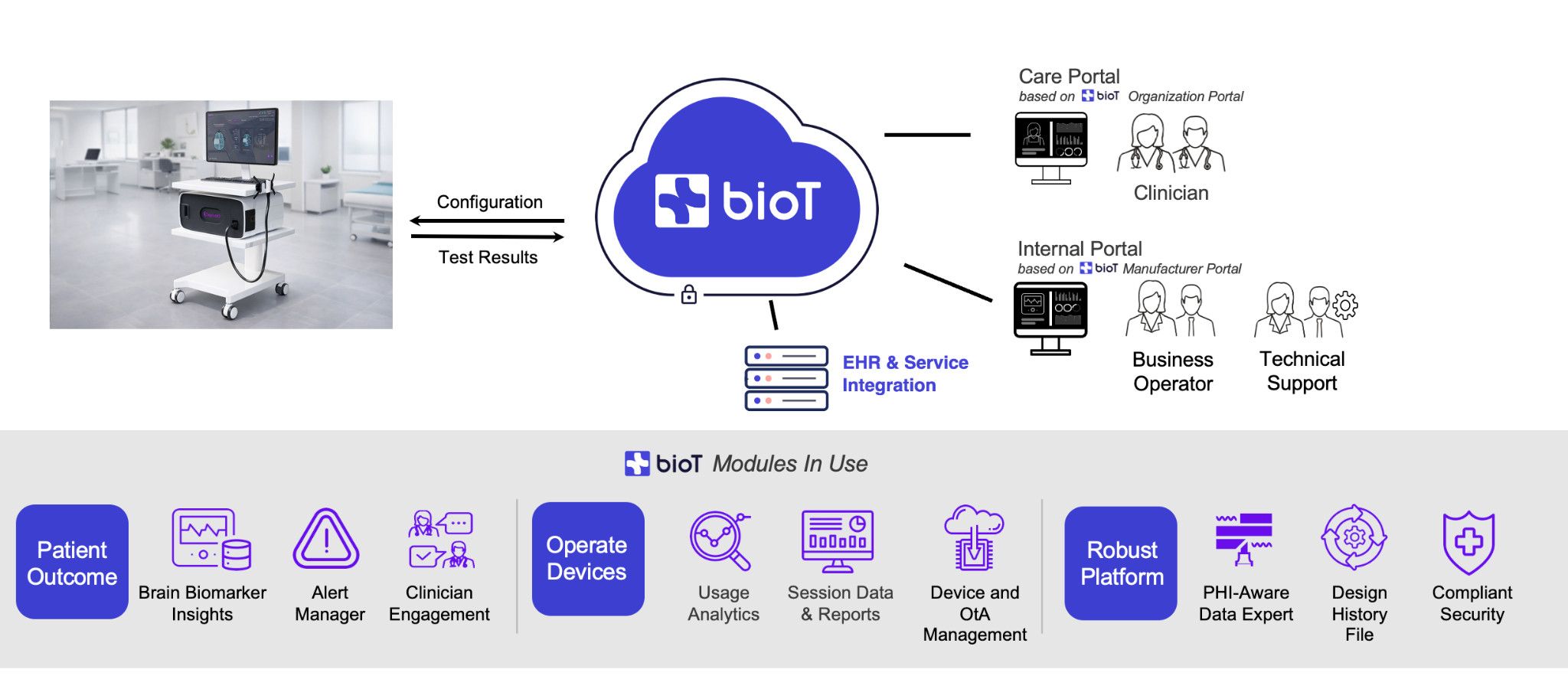
Delphi-MD session data flows via API into the BioT stack, patient engagement, biomarker insights, privacy and access, device and FOTA management, and session reporting, then out to the care, operations, and EHR endpoints over a secure data layer.
The flow is straightforward. At the end of each Delphi-MD session, the device securely uploads its results to BioT through standard APIs. BioT processes and stores the results, and clinicians and QuantalX users view them through BioT's out-of-the-box portals, with the summary report embedded directly in the portal.
BioT also covers the operational layer QuantalX did not want to build:
- A model where each clinic or HMO is its own organization, with role-based access for manufacturer admins, organization admins, clinicians, and patients, governed by attribute-based access control.
- Firmware and software update management over the air, through remote configuration and version groups using secure, time-limited download links.
- Device support tooling, including log upload, configurable log levels, and plugin-driven alerts.
- License management across clinics and devices.
Because BioT maintains security and availability at the platform layer, the QuantalX team can stay focused on its device and its science rather than on infrastructure. Onboarding followed a defined path with a dedicated BioT solution architect and customer success lead: kickoff, solution review, and platform training, then iterative buildout of the data, firmware-update, and licensing flows.
“BioT lets us connect Delphi-MD to the cloud and scale into new markets without building or maintaining cloud and security infrastructure ourselves.”
What the partnership unlocks
Working with BioT, QuantalX is bringing Delphi-MD to more clinical sites as a connected, cloud-enabled product, without standing up a cloud engineering function. The partnership is designed to deliver:
- A medical-grade platform layer with security certified and audited by BioT, reused out of the box instead of built in-house.
- A clear path to connected care: secure device-to-cloud data upload, centralized data, and remote fleet management.
- Self-service configuration and plugins so QuantalX can adapt the system as requirements evolve, rather than waiting on backend development cycles.
- Reduced ongoing burden for platform-layer security and maintenance.
Looking ahead
QuantalX continues to expand Delphi-MD on BioT, including a more clinician- and patient-facing application experience and broader use of data to support ongoing research and future algorithm development. As QuantalX scales adoption across more clinical sites in the US and EU, BioT provides the connected-device foundation so the team can keep its focus on brain health, not infrastructure.


